
IT Financial Management
Control costs, demonstrate value contributions. Control your IT spending from its origin to its allocation to specialized departments.
Leading organizations trust us





How Does IT Financial Management Work?
Real-time data on cost generation and development provides you with the basis for optimal use of financial resources. Stakeholder-oriented dashboards and reports facilitate decision-making and simplify communication with specialized departments regarding cost allocation.
Industry-standard cost models (Bee Approach, TBM, CIGREF, and others) provide a logical taxonomy and allow you to leverage and integrate structures from your financial systems. This makes the value contribution of IT transparent.

Recognized by leading industry analysts
Bee360 listed as a vendor in the Gartner Market Guide for IT Financial Management 2025.
Read moreBee360 appears in the Forrester Report: The IT Financial Management (AKA TBM) Technology Solution Ecosystem for its comprehensive ITFM capabilities.
Access the reportAnalysis
Create the foundations, identify optimization potentials, use accurate forecasts
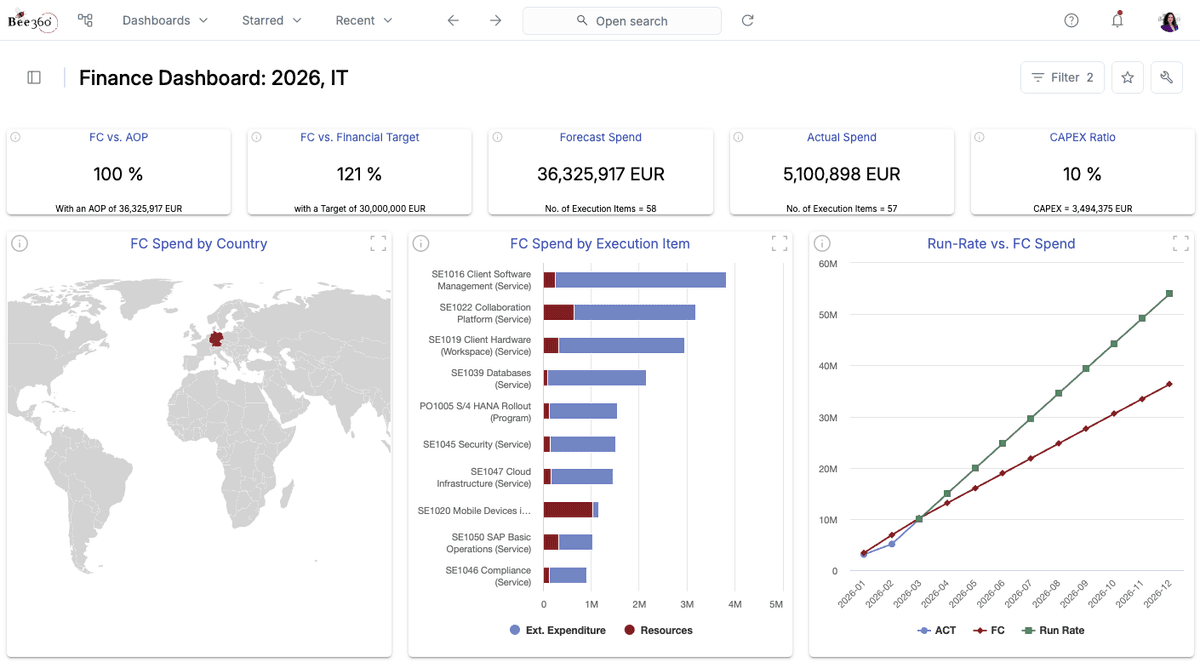
Create ITFM Foundations
Establish the foundations for global governance. Industry-standard cost models (Bee Approach, TBM, CIGREF, and others) provide a logical taxonomy and allow you to leverage and integrate structures from your financial systems.
Identify Optimization Potentials
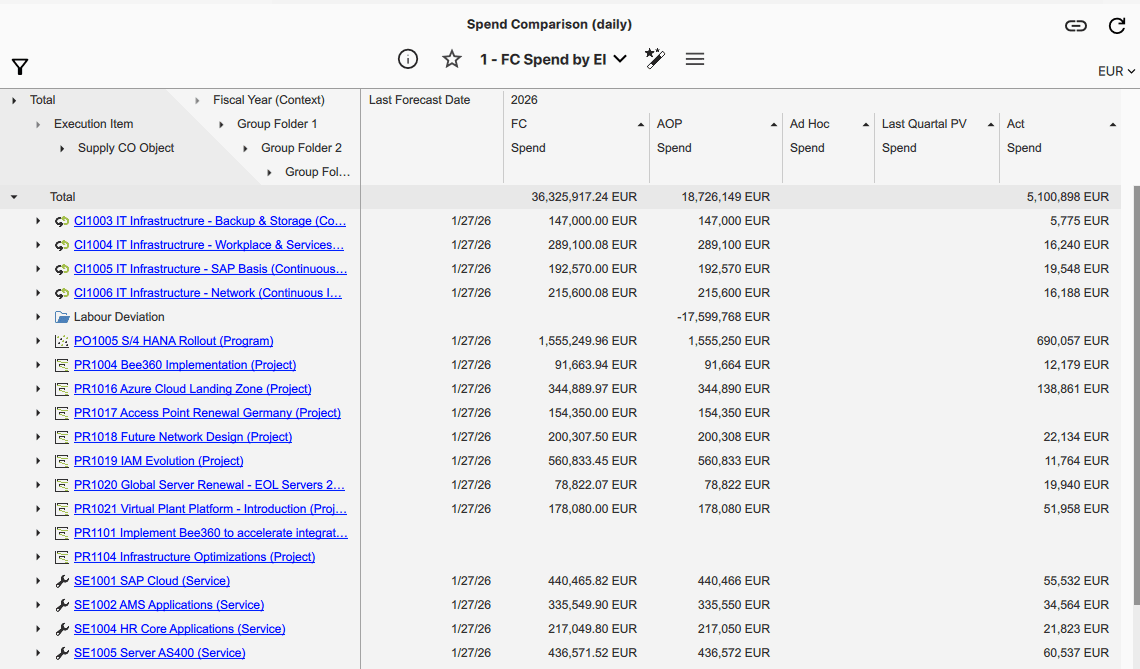
Identify your cost drivers on a data basis and continuously optimize them. Use this information to create effective control from strategy implementation to operational costs. This way, you can identify financial opportunities that accelerate innovation.
Use Accurate Forecasts
Avoid unnecessary expenses by knowing what costs await you. Optimize the use of your resources and integrate suppliers in a targeted manner, also with the help of automated variance analyses that account for all planning states.
Planning
Rationalize portfolios, identify opportunities, channel demand
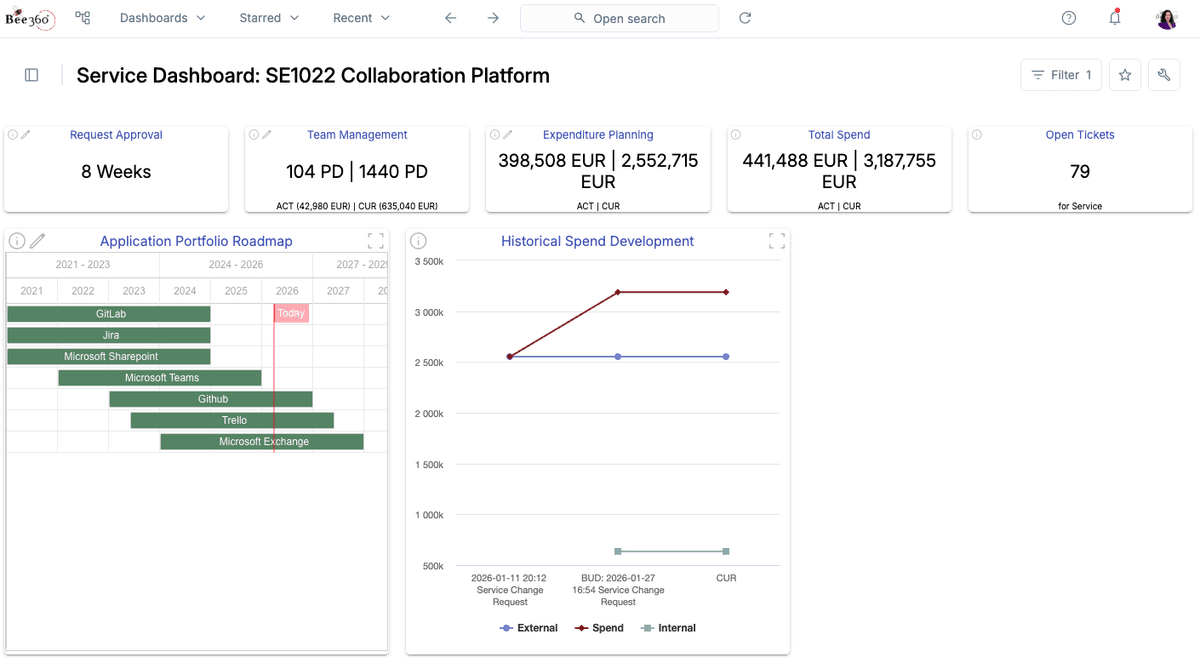
Rationalization of Application and Service Portfolios
Ensure that your platforms and applications provide the best possible impact through distributed accountability and business collaboration. Selective replacement of costly applications with limited value and implementation of future-oriented architectures and roadmaps.
Identify Optimization Opportunities
Minimize data entry efforts by using existing data from surrounding systems (ERP, IT) via standard connectors. Missing data is collected centrally or decentrally and processed and calculated automatically.
Understand and Channel Demand
Bee360 is suitable for both small local IT and global corporations. Obtain service purchase quantities through intelligent recording or extrapolation. Manage new requirements selectively and avoid unnecessary duplication of applications, whether you have a centralized or federated operating model.
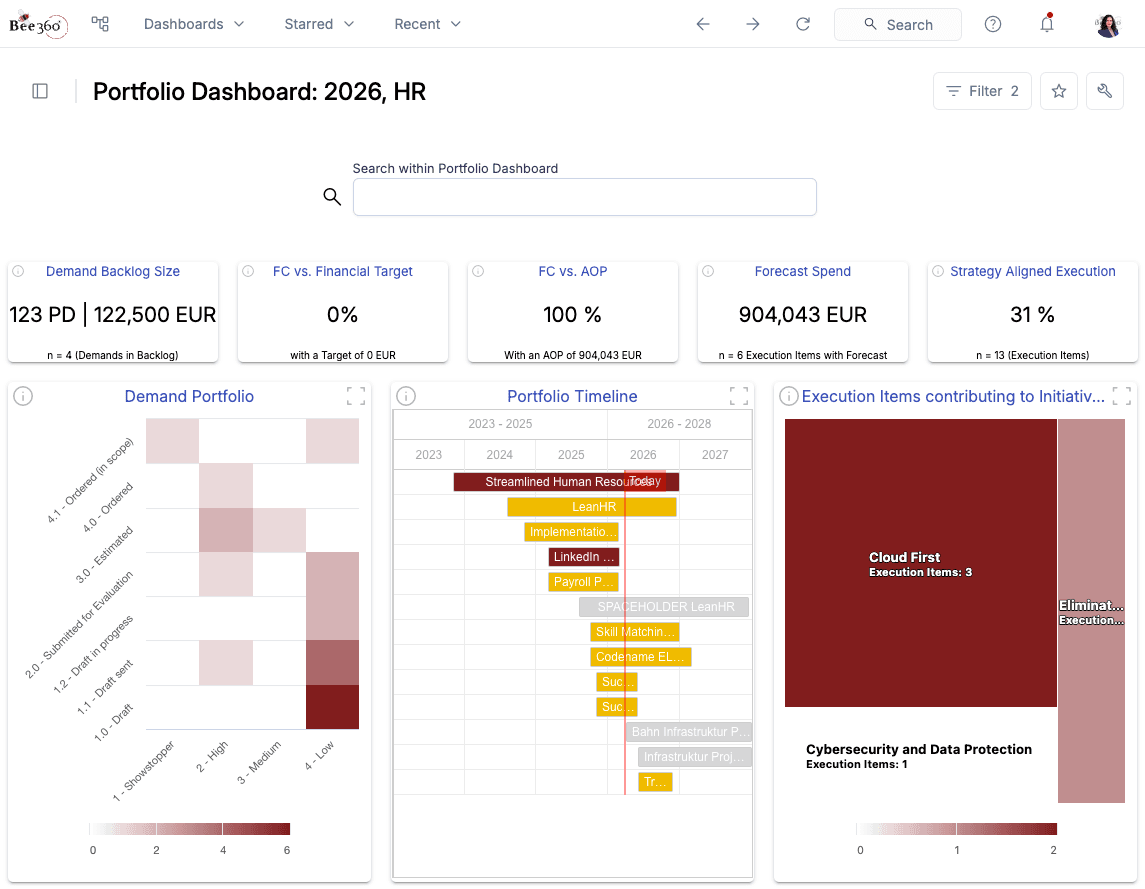
Accounting
Automated billing, business collaboration, IT as success factor
Automated Billing
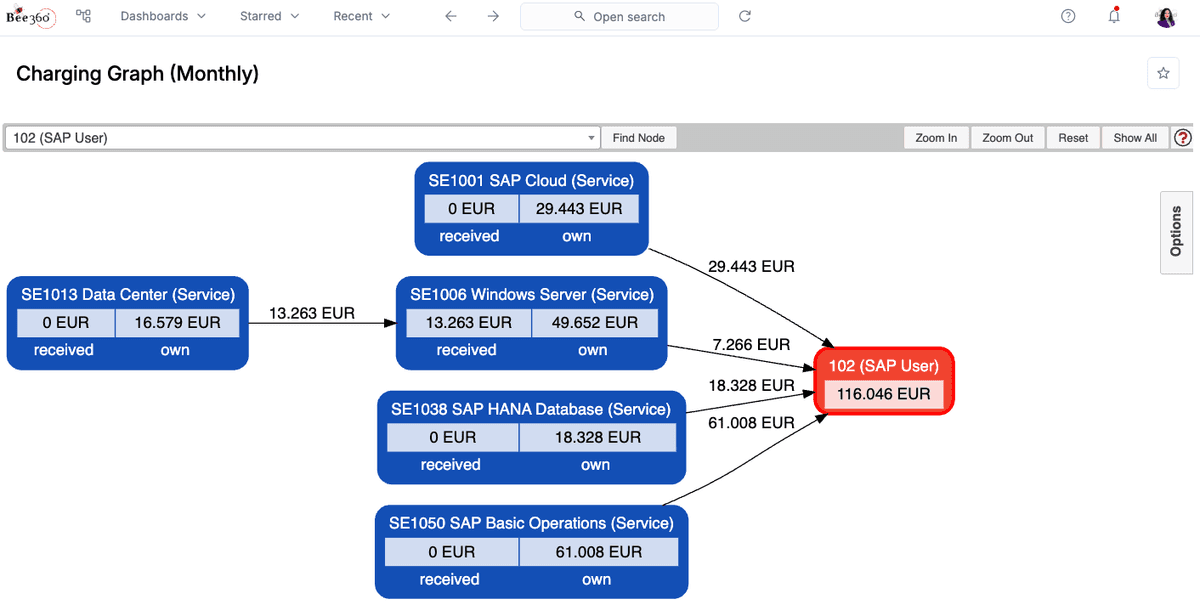
The calculation of settlement and transfer to the financial system are automated. Whether for internal, group-level, or external billing. Billing information is also generated automatically and delivered by email or made available via the portal. If corrections are required, you will receive them automatically from the system.
Business Unit Collaboration
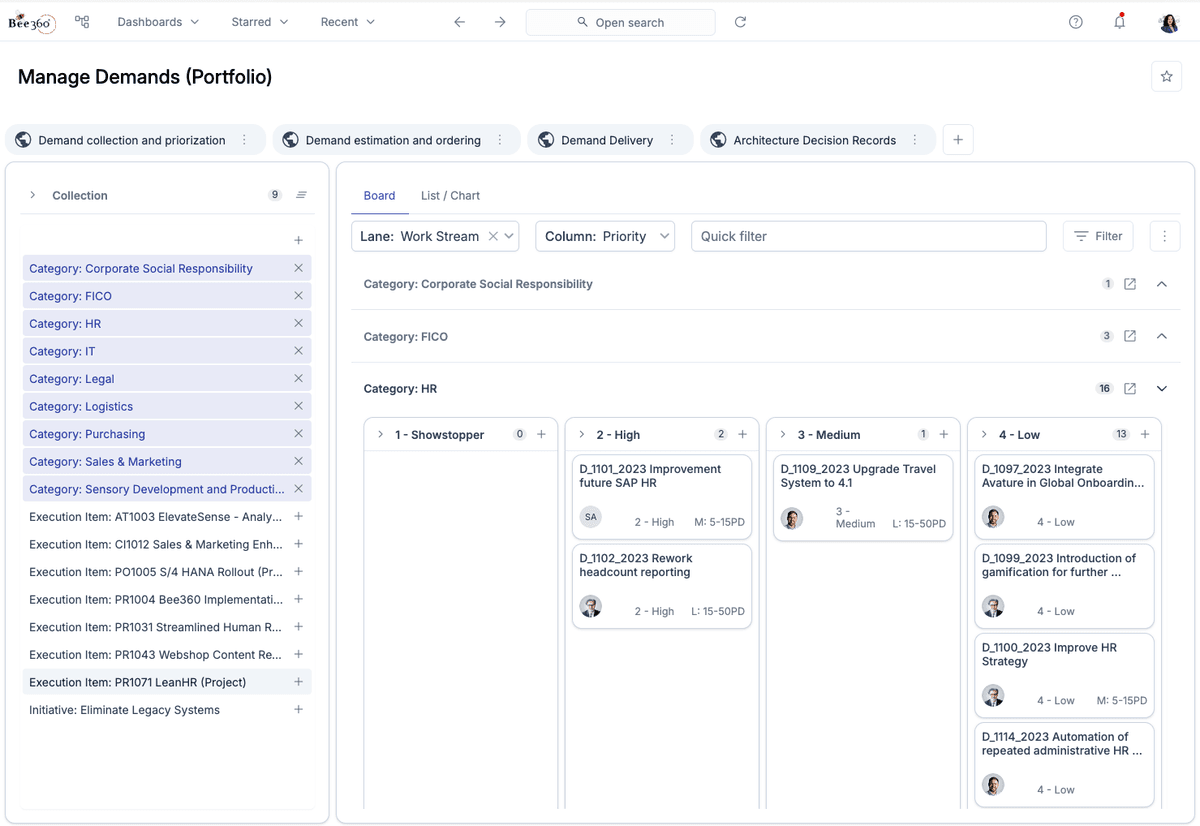
Achieve broad consensus on technology investments by demonstrating the value IT provides with Bee360. Priority conflicts resolved at the expense of IT are a thing of the past. The clear service offering through the service catalog supports this additionally.
IT as a Business Success Factor
Avoid unnecessary IT through intelligent demand management. Distinguish between volume-driven and demand-driven cost changes. Promote the introduction of new services or the discontinuation of existing services with appropriate subsidy strategies.
Unbeatable ROI – 3x Faster Implementation
Minimal effort, maximum transparency, predictive power
Minimal Effort
Bee360 reduces the control effort by up to 95%. This saving is achieved exclusively through intelligent processes; the effort is not transferred to other parts of the organization.
Maximum Transparency
Bee360 creates easily accessible transparency at the desired granularity for all relevant roles, such as CEO, CFO, CIO, controlling, cost center, service and project managers, customers, and suppliers.
Predict the Future
With integrated planning, you know what is going to happen: what resources are planned for what scope and what expenses are planned. This way, you can determine what should happen and create enormous competitive advantages.
What Our Customers Say


Relevant Content for IT Financial Management
In-depth resources to help you master ITFM
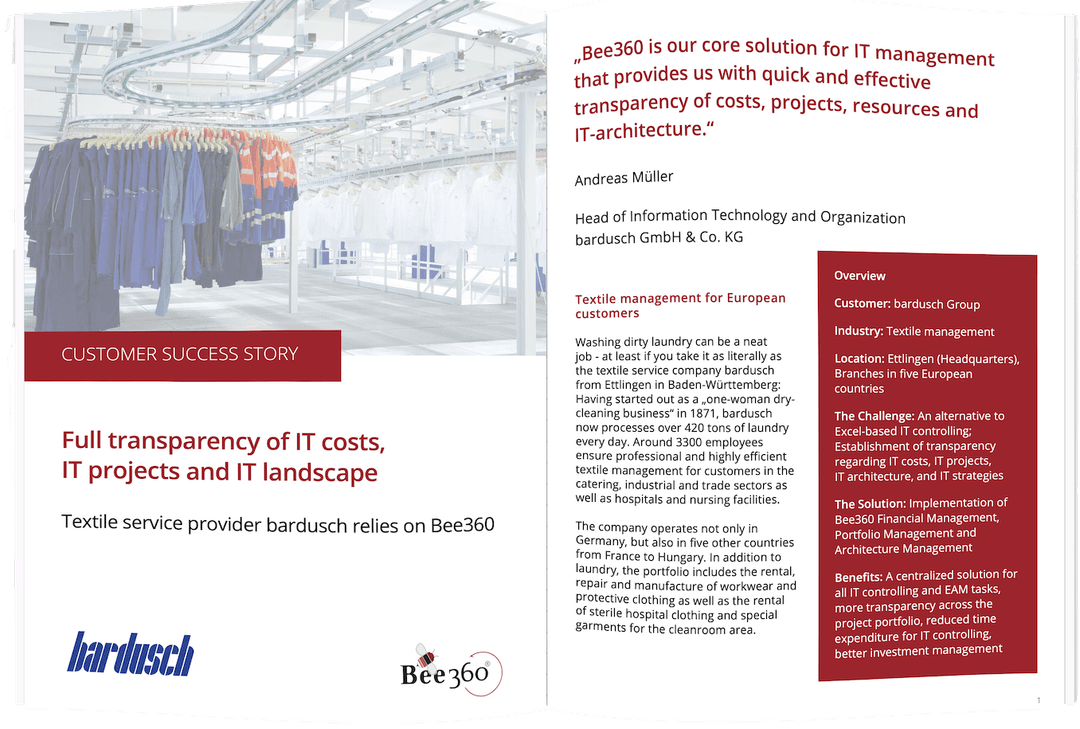
Customer Success: Bardusch
See how Bardusch optimized IT financial management with Bee360
Read Case Study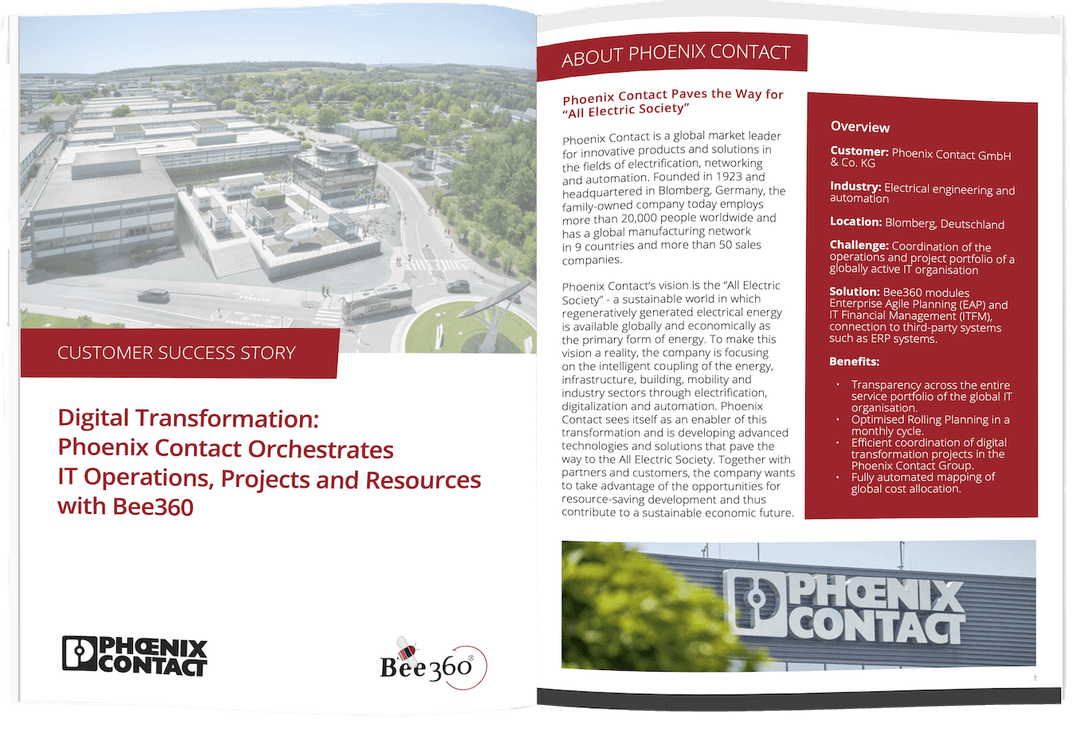
Customer Success: Phoenix Contact
Discover how Phoenix Contact transformed its IT financial management
Read Case Study
Expert insights on IT Financial Management trends
Forrester Principal Analyst Gordon Barnett shares key ITFM perspectives
Watch NowExplore our integrated platform
Bee360 connects Strategic Portfolio Management, IT Financial Management, and Enterprise Architecture Management in one unified solution.
Strategic Portfolio Management
Align IT investments with business strategy and manage demand effectively.
Learn moreEnterprise Architecture Management
Strengthen IT integration with specialized departments and develop EAM as a valuable business enabler.
Learn moreHave Questions? Get in Touch With Us.
Grab 15 minutes with our team for straight answers to your questions.
Just 15 minutes
Fast answers
Ask us anything about Bee360
No commitment required
Frequently Asked Questions
Bee360 complements SAP. SAP is the system of record for bookings: cost centers, cost elements and the accounting view. Steering IT needs a different view: costs by service, application, project and supplier, linked to capacity and portfolio decisions, with planning and rolling forecasts.
Yes. Bee360 brings together internal personnel costs (including cost centers and locations), external services and consultants, suppliers and contracts, licenses and maintenance, and assigns them to the services, applications, projects and continuous improvements they serve. Costs can be analyzed by cost type, vendor, organizational unit or business domain.
Yes. Reducing costs strategically does not mean cutting every budget by the same percentage. It means deciding which costs to stop because they deliver too little, and that decision is only possible when you know where costs originate and what they deliver.
Isolated ITFM tells you what was spent, but not why, and not what to do about it. Technology costs are driven by portfolio decisions and strategic execution, so financial steering needs to see those decisions. Without that link, the business tends to perceive IT as free, and makes technology decisions that create complexity and additional cost.